

Radiofrequency Ablation for Chronic Back Pain: What to Know Before You Consider It: Back pain is the world’s leading cause of disability, affecting more than 619 million people around the globe in 2020. If rest and stretching have eased your discomfort but never quite cleared it, you are far from alone, and you have more paths forward than you might expect.
Radiofrequency ablation uses targeted heat to quiet the nerves behind stubborn joint pain. This article walks through what ablation for chronic back pain actually does, how well it can work, and the questions worth settling before you decide.
What Is Radiofrequency Ablation for Chronic Back Pain?
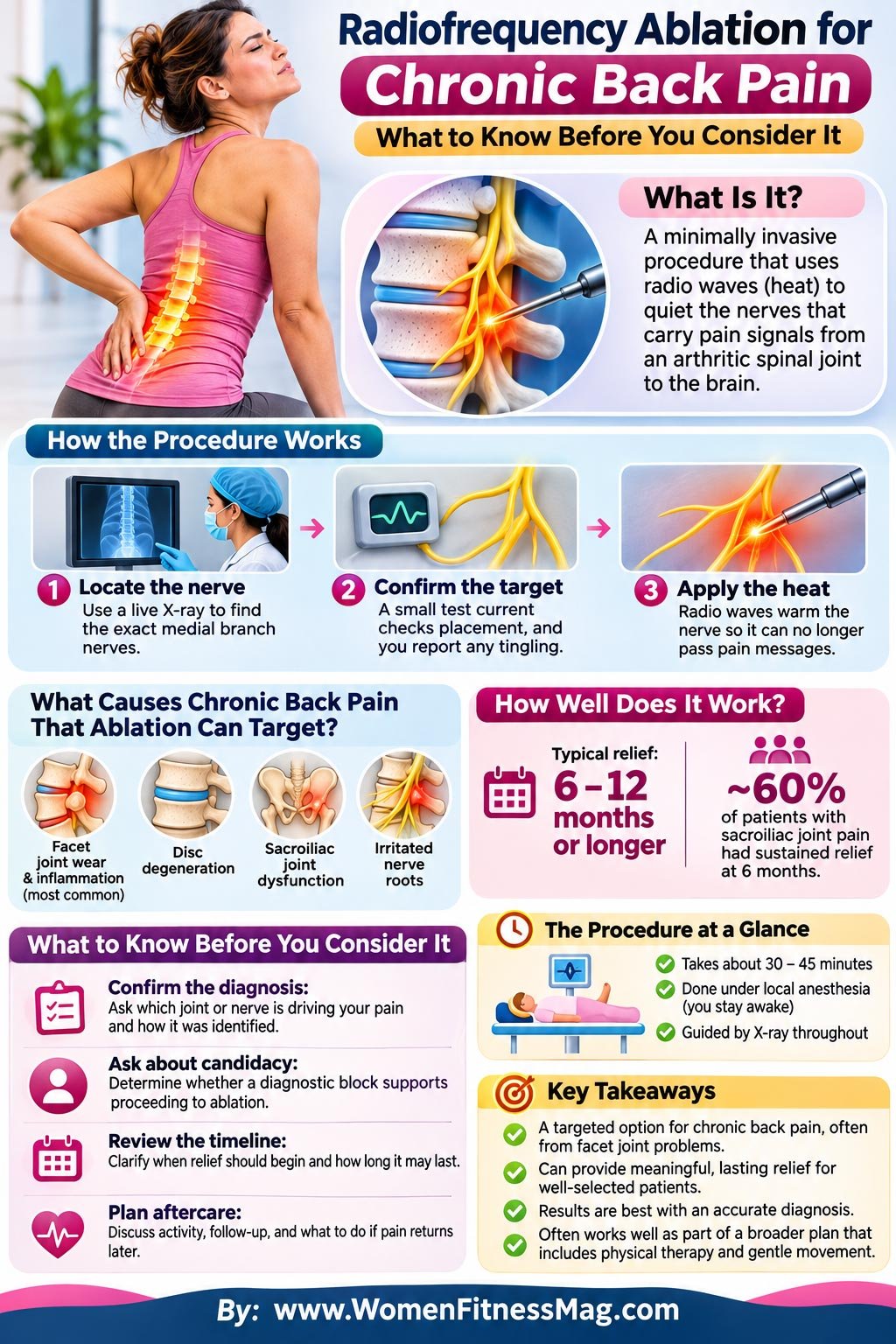
Radiofrequency ablation is a minimally invasive procedure that uses radio waves to heat your nerves so that they stop carrying pain signals from an arthritic spinal joint to the brain. Ablation treats the messenger rather than cutting or fusing anything.
Targeted options matter because low back pain lies on a vast scale. One 2025 analysis counted 452.8 million working-age cases worldwide, a 52.66% rise since 1990. The procedure runs through a thin needle guided by X-ray, with no incision.
Here is how the procedure unfolds once you are positioned on the table:
- Locate the nerve: The physician uses a live X-ray to find the exact medial branch nerves feeding the painful joint.
- Confirm the target: A small test current checks placement, and you report any tingling so that the site stays precise.
- Apply the heat: Radio waves warm the nerve until it can no longer pass pain messages upward.
Relief typically builds over the following weeks as the treated nerve settles, which raises a fair question about how much improvement to expect. Ablation only helps when the right joint is driving the discomfort, which is why pinpointing that source comes before anything else.
What Causes the Chronic Back Pain That Ablation Can Target?
Chronic back pain most often traces to the facet joints, the small stabilizers along the spine that wear and inflame with age. Ablation reaches those joints through the medial branch nerves that carry their pain signals.
Other drivers include disc degeneration, sacroiliac joint dysfunction, and irritated nerve roots, each of which responds differently to ablation. Genetics can also shape who develops lasting pain. All these factors can cause chronic back pain, and with an accurate diagnosis, you can decide whether ablation is a sensible fit.
So the first job is naming the pain generator with precision. From there, a specialist can map out whether ablation, another intervention, or a combination fits your case best.
How Well Does Ablation Work, and How Long Does Relief Last?
A 2025 medical review found that for well-selected patients, ablation targeting the facet joints typically provides relief lasting six to 12 months or longer. For sacroiliac joint pain specifically, the same review cites real-world data showing roughly 60% of patients had sustained relief at six months.
Results hinge on careful patient selection and an accurate diagnosis. Because the treated nerves can slowly regrow, pain might return over time, making ablation a durable part of a longer plan rather than a solution.
Paired with physical therapy, gentle movement, and other treatments for lower back pain, ablation can reduce daily discomfort. This helps you get back to normal life and stay active while the rest of your recovery plan does its part.
What Should You Know Before You Consider Ablation?
Before ablation, most specialists confirm the source of your pain with a diagnostic step. A medial branch block or a temporary numbing injection tests whether the suspected nerves are truly responsible.
The procedure itself takes about 30 to 45 minutes, done while you lie face down under local anesthesia and stay awake, with X-ray guidance throughout. Patients exploring radiofrequency ablation in Stillwater, OK, typically begin with that confirmatory block first, which protects both your time and your odds of a strong result.
A short list of questions helps you walk in prepared:
- Confirm the diagnosis: Ask which joint or nerve is driving your pain and how it was identified.
- Ask about candidacy: Determine whether a diagnostic block supports proceeding to ablation.
- Review the timeline: Clarify when relief should begin and how long it may last.
- Plan aftercare: Discuss activity, follow-up, and what to do if pain returns later.
Walking in with those answers makes a large decision manageable. With the diagnosis clear and expectations set, you are ready to judge whether this path fits your body and your goals.
Get Chronic Back Pain Relief with Ablation
Chronic back pain is common, but it does not have to be permanent, and ablation can help you turn down the volume on a specific, well-identified source. Because research consistently shows meaningful improvement for well-selected patients, this precise, targeted approach is well worth considering for those who have tried gentler measures without enough relief.
A clear conversation with a qualified pain specialist comes first, someone who can confirm the source of your pain and shape a plan around your goals. Understand what the treatment can and cannot do, ask the questions that matter, and you can approach the decision with confidence and with a realistic sense of the relief ahead.
Related Infographics: