

What a Stellate Ganglion Block Can Do for Nerve Pain in the Arm, Hand, or Face : The wrist fracture healed weeks ago, but the hand still looks swollen and shiny. A shirt cuff brushing the skin can feel like a burn, and the pain seems far worse than the original injury should explain.
Then a doctor suggests a stellate ganglion block. Why would an injection in the neck help a hand that hurts?
Quick Answer
A stellate ganglion block temporarily interrupts sympathetic nerve signals on one side of the neck. Doctors use it to investigate or treat certain pain conditions, including complex regional pain syndrome (CRPS). Some patients experience relief, but research has not established a reliable, lasting benefit for CRPS. The procedure is also being studied for PTSD, although it is not an established PTSD treatment.
Why a Neck Injection Can Affect Pain in the Hand
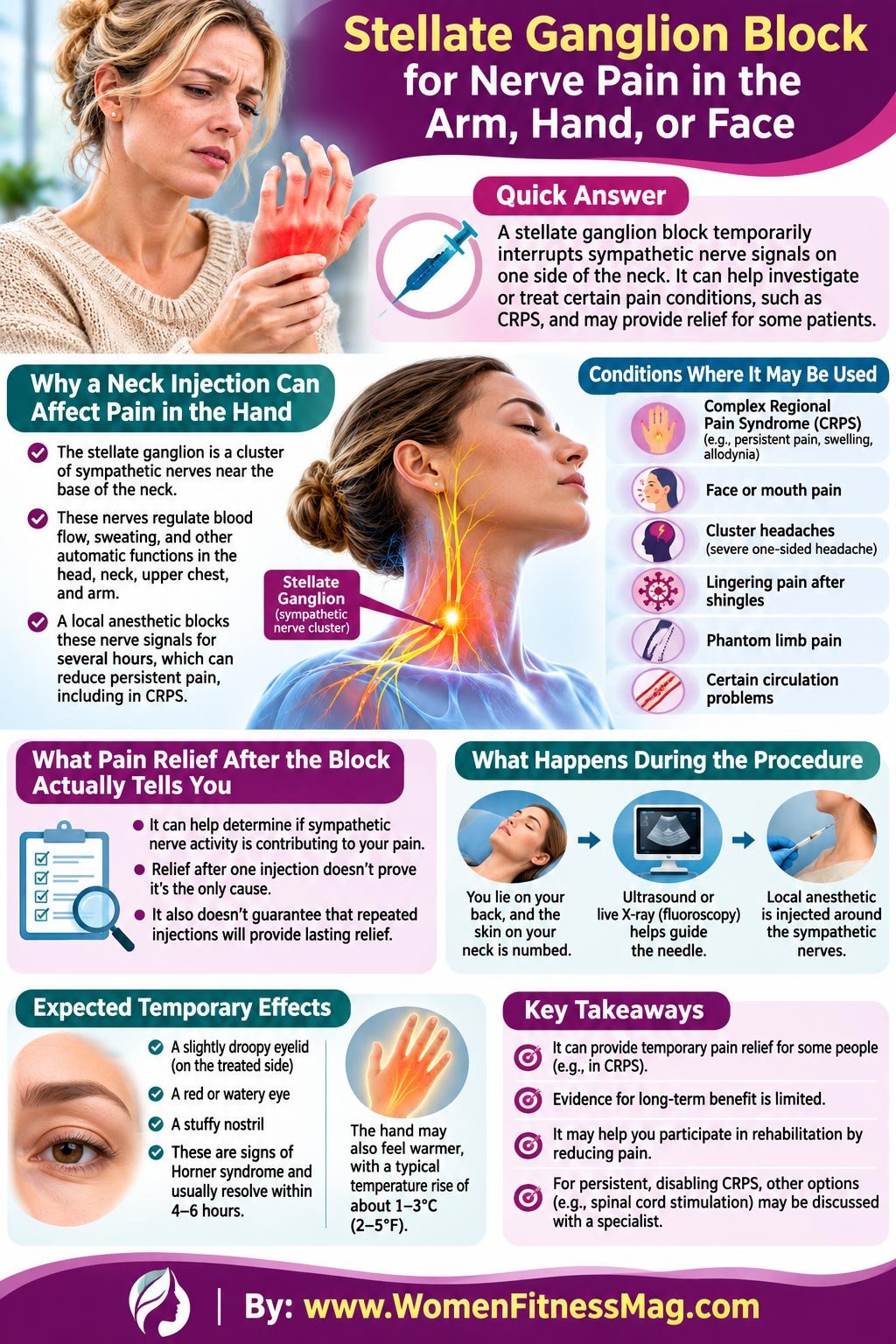
The stellate ganglion is a cluster of sympathetic nerves near the base of the neck, close to the voice box and first rib. These nerves help regulate automatic functions such as sweating and blood flow in parts of the head, neck, upper chest, and arm.
A stellate ganglion block places local anesthetic around that nerve cluster, interrupting its activity for several hours.
In some lasting pain conditions, sympathetic activity appears to keep pain going after the original tissue has healed. It can also change blood flow, sweating, and skin temperature, which is why an affected hand may look blotchy, feel unusually hot or cold, or sweat more than the other hand.
Complex regional pain syndrome, or CRPS, is the clearest example. It sometimes develops after a fracture, surgery, or another injury, and the affected hand or arm can stay swollen long after the injury itself has healed.
Pain from a shirt cuff or bedsheet is called allodynia, meaning something ordinarily harmless causes pain. Not everyone with CRPS has pain driven by sympathetic activity, though, which is one reason a nerve block doesn’t help every patient.
Doctors also use stellate ganglion blocks for selected cases of lingering pain after shingles, phantom limb pain, and certain circulation problems. Because the same ganglion supplies the head, Cleveland Clinic’s list also includes uses in the face: pain felt in the face or mouth, and cluster headaches, which cause severe one-sided pain around an eye. In each case, the question resembles the one in CRPS: whether sympathetic activity seems to be feeding the pain, and whether treatments built for that specific condition have already been tried.
What Pain Relief After the Block Actually Tells You
A stellate ganglion block can help investigate whether sympathetic nerve activity contributes to someone’s pain. If the familiar burning sensation eases while those nerves are temporarily blocked, that response suggests a sympathetically maintained component.
But pain relief after one injection doesn’t prove that the sympathetic nervous system is the only cause. Nor does a successful temporary block establish that repeated injections will provide lasting relief.
A 2016 Cochrane review examined 12 studies involving 461 participants who received local anesthetic sympathetic blocks. The research covered different blocking techniques, not exclusively stellate ganglion injections.
The small placebo-controlled studies did not establish a significant short-term pain benefit. Across the review, the evidence was mostly low or very low quality, and the authors could not draw firm conclusions about effectiveness or safety.
The 2022 CRPS treatment guidelines from Harden and colleagues also describe limited evidence for sympathetic blocks. So why might a doctor still recommend one? The guidelines put restoring movement and function first, and some patients appear to get a period of lower pain that lets them take part in rehabilitation more comfortably. A block is sometimes considered when pain keeps a patient from making progress.
Less burning pain is useful, but being able to move the fingers, tolerate clothing, or participate in therapy may matter just as much. For persistent CRPS that remains disabling despite appropriate treatment, specialists may eventually discuss other options, including spinal cord stimulation.
What Happens During a Stellate Ganglion Block
The procedure is usually performed as an outpatient visit, part of the pain management Elizabeth NJ residents can get without a hospital stay. Patients lie on their backs while the clinician cleans the neck and numbs the skin. Ultrasound or fluoroscopy, a form of live X-ray, helps guide the needle toward the intended area. Local anesthetic is then injected around the sympathetic nerves.
The injection itself generally takes less than 30 minutes. Afterward, patients remain under observation while staff monitor for temporary effects or complications. Cleveland Clinic describes a typical recovery-room period of approximately 40 to 60 minutes. Anyone arranging the procedure should ask about imaging guidance, sedation, transportation, and how long the appointment is expected to take.
Why a Droopy Eyelid or Warmer Hand Can Be Expected
Within minutes of the injection, the eyelid on the treated side may begin to droop slightly. The eye can become red or watery, and the nostril on that side may feel stuffy. These temporary changes are associated with Horner syndrome, which can occur when sympathetic nerve activity is interrupted. They generally resolve as the anesthetic wears off, often within four to six hours.
The hand may also feel warmer as blood vessels respond to the block. According to StatPearls’ neuroanatomy review, temperature in the affected extremity may rise by approximately 1 to 3 degrees Celsius, or about 2 to 5 degrees Fahrenheit.
These changes can provide evidence that the intended sympathetic nerves were affected. They don’t necessarily mean the entire upper limb has been successfully blocked, or that the patient’s pain will improve.
A temporary hoarse voice or difficulty swallowing may also occur because the medication can affect nearby structures. Until swallowing returns to normal, patients should follow their clinic’s instructions about when to resume food and drinks, and a few small sips of water make a sensible first test.
Arrange for someone to drive home. Temporary visual changes, weakness, and any sedation can affect the ability to drive safely, even when the procedure itself went smoothly.
Which Side Effects Need Medical Attention?
Soreness or a small bruise near the injection site is possible. More serious complications are uncommon but can include bleeding, infection, nerve injury, or a collapsed lung. University of Maryland Medical Center also notes that, rarely, medication reaching a blood vessel can cause a seizure.
Persistent difficulty swallowing, fever, increasing redness, or drainage from the injection site should be reported promptly to the treating clinician. New shortness of breath, significant neck swelling, or chest pain requires emergency evaluation.
What the PTSD Research Shows So Far
Researchers have also investigated stellate ganglion blocks for post-traumatic stress disorder (PTSD), partly because the sympathetic nervous system plays a role in the body’s fight-or-flight response.
In a randomized trial published in JAMA Psychiatry in 2019, researchers enrolled 113 active-duty service members with PTSD symptoms. Participants received either two stellate ganglion blocks or two sham procedures, with the treatments given two weeks apart.
After eight weeks, the adjusted average improvement on the 80-point Clinician-Administered PTSD Scale was 12.6 points in the block group, compared with 6.1 points in the sham group. The researchers had identified a 10-point change as a clinically meaningful benchmark. The average improvement in the block group exceeded that threshold, but the finding was limited by the relatively short follow-up and the characteristics of the participants.
The 2023 VA/DoD Clinical Practice Guideline for PTSD found insufficient evidence to recommend for or against stellate ganglion blocks, which isn’t the same as finding that the procedure never helps.
The guideline continues to recommend established trauma-focused therapies for PTSD, including cognitive processing therapy, prolonged exposure, and EMDR. Medication is another evidence-based option, and a block isn’t a substitute for either without input from the treating mental health professional.
What to Ask Before Another Block
Some patients receive more than one stellate ganglion injection. Before scheduling another, it helps to review what the previous procedure actually accomplished.
Three questions deserve attention:
- How much did the usual pain change, and for how long?
Temporary warmth or eyelid droop confirms a physiological effect, not necessarily meaningful pain relief. - Did daily function improve?
Being able to close the hand, tolerate clothing, or participate in therapy can provide useful information alongside pain scores. - What improvement would justify repeating the procedure?
The clinician should be able to explain the purpose of another injection and how the response will be evaluated.
Questions Patients Ask About Stellate Ganglion Blocks
How Long Does a Stellate Ganglion Block Last?
The local anesthetic generally wears off within hours, but some patients report pain relief lasting days or weeks. Relief doesn’t necessarily grow with each repeat injection, and the evidence hasn’t established a reliable long-term benefit for CRPS.
For PTSD, the prominent randomized trial followed participants for eight weeks after the first treatment. It cannot establish how long any benefit persists beyond that period.
Who Should Not Have a Stellate Ganglion Block?
An active infection near the injection site or an allergy to the intended medication may prevent the procedure. Patients taking blood thinners need an individualized plan, and they should never stop prescribed anticoagulants without direction from the appropriate clinician. StatPearls also identifies certain cardiac conduction abnormalities and glaucoma as conditions requiring particular caution.
Can the Block Help Anxiety or Depression?
Stellate ganglion blocks are not established treatments for anxiety or depression. Researchers have looked at psychiatric uses, but the evidence isn’t strong enough to justify the procedure in place of proven care for anxiety or depression.
Take a Photo of the Hand Before the Block
With CRPS, a hand’s color and swelling can change from day to day. Memory alone makes those changes difficult to compare.
A photograph before treatment and another taken afterward, under similar lighting, may help document visible differences. The same camera angle and position make the comparison more useful.
A photo can’t show everything, so write down whether a shirt cuff still hurts, how far the fingers can comfortably close, and whether the hand feels warmer or less painful. Record when those changes begin and when they fade. Avoid forcing painful movements, and follow the clinician’s activity instructions.
Bring the photos and notes to the follow-up appointment. They won’t establish whether the treatment worked on their own, but they give the doctor a clearer picture of the patient’s response when deciding what to do next.
Related Infographics: