



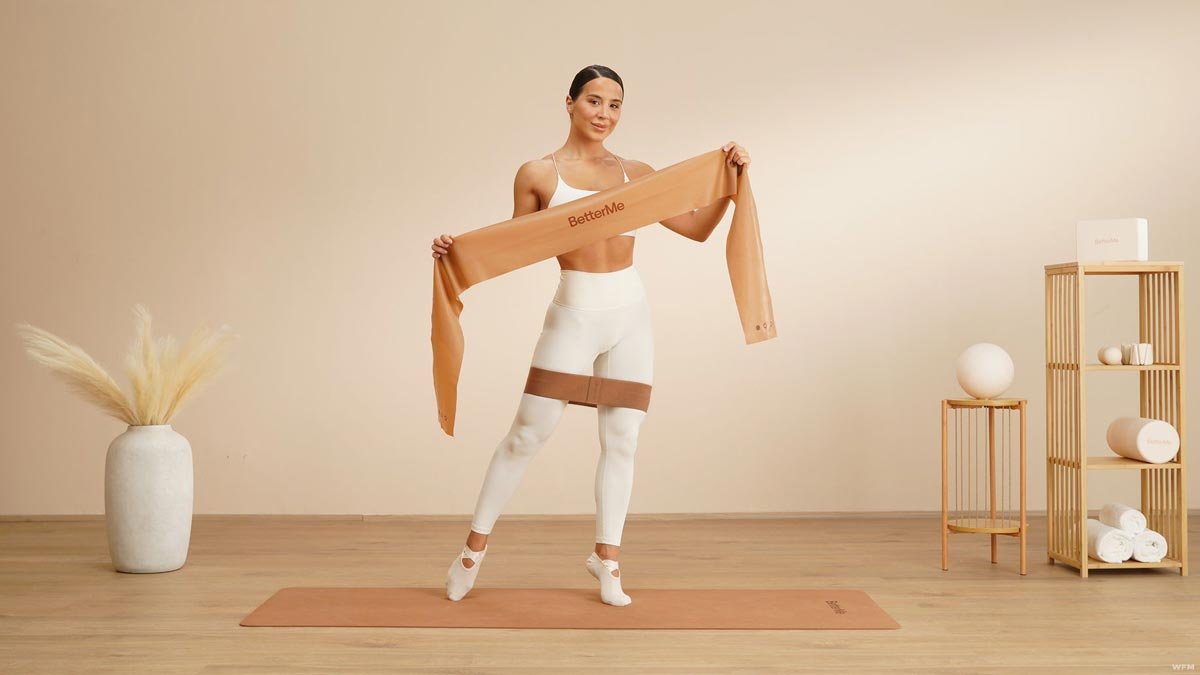
Why Bands for Pilates Can Help Add Control and Resistance to Mat Workouts : If your mat routine has started to feel a little too familiar, bands can be a smart next step. They add challenge without changing the feel of Pilates too much. You still get the slow, controlled style of movement—just with a little more resistance.
That is why bands for Pilates appeal to many people. They are light, easy to store, and simple to use at home. If you like the idea of adding intensity without reaching for dumbbells, they can be a very practical option.
In this guide, we’ll look at how bands compare with free weights, how to choose between long bands and resistance loops, and how to use them in a simple full-body routine. We’ll also cover a few tips that can help your workouts feel smoother and your equipment last longer.
Free Weights vs. Resistance Bands
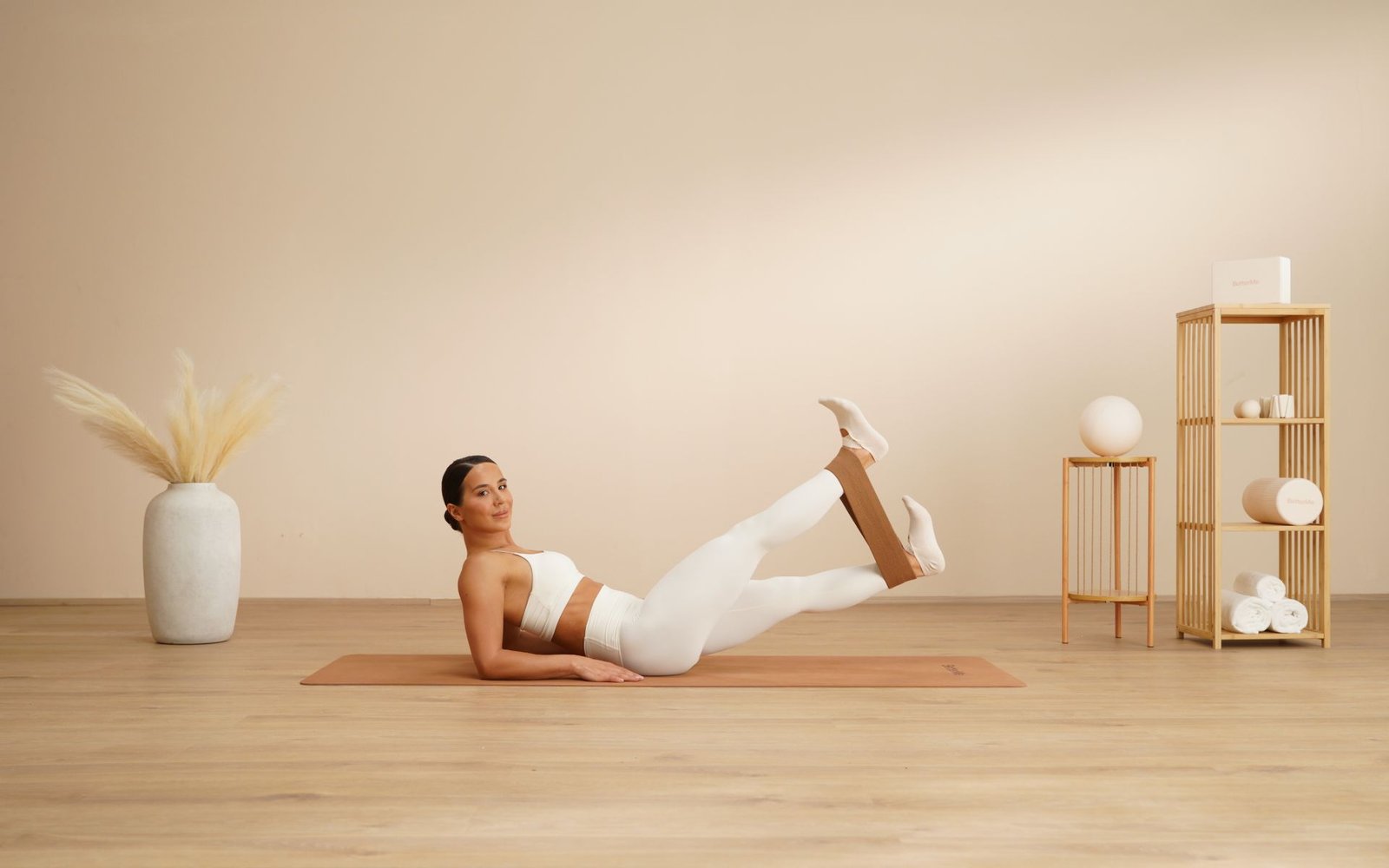
Free weights and bands can both make your workouts more challenging, but they do it in different ways. If you enjoy Pilates because it feels controlled and intentional, bands often fit that style especially well.
One reason is constant tension. With a band, the resistance stays with you through the whole movement. You feel it as you press, pull, and return. That can make each rep feel more connected, instead of just moving from point A to point B.
Bands also make it harder to rush. You cannot really swing through a movement the way people sometimes do with weights. The band asks you to slow down, stay steady, and pay attention. For Pilates, that is a pretty natural match.
This can be especially helpful if you want more control, not just more intensity. A slower rep often gives you more feedback. You can notice when your shoulders creep up, when your ribs flare, or when your hips shift more than you expected.
Another plus is that bands are easy to adjust. You can shorten the band, widen your grip, or switch to a different level of resistance. That gives you a lot of flexibility without needing a full rack of equipment.
When used well, bands can also support joint mobility because they allow a more adaptable path of movement. Instead of forcing you into one fixed position, they give you some room to work with your own range.
And then there is the practical side. Bands are small, light, and easy to keep in a drawer, basket, or tote. If you work out at home, or just do not want more bulky equipment around, that matters.
So while free weights can be useful, bands for Pilates tend to work especially well for people who want controlled strength work, better movement awareness, and a little more challenge without losing the flow of their routine.
Long Bands vs. Loop Bands
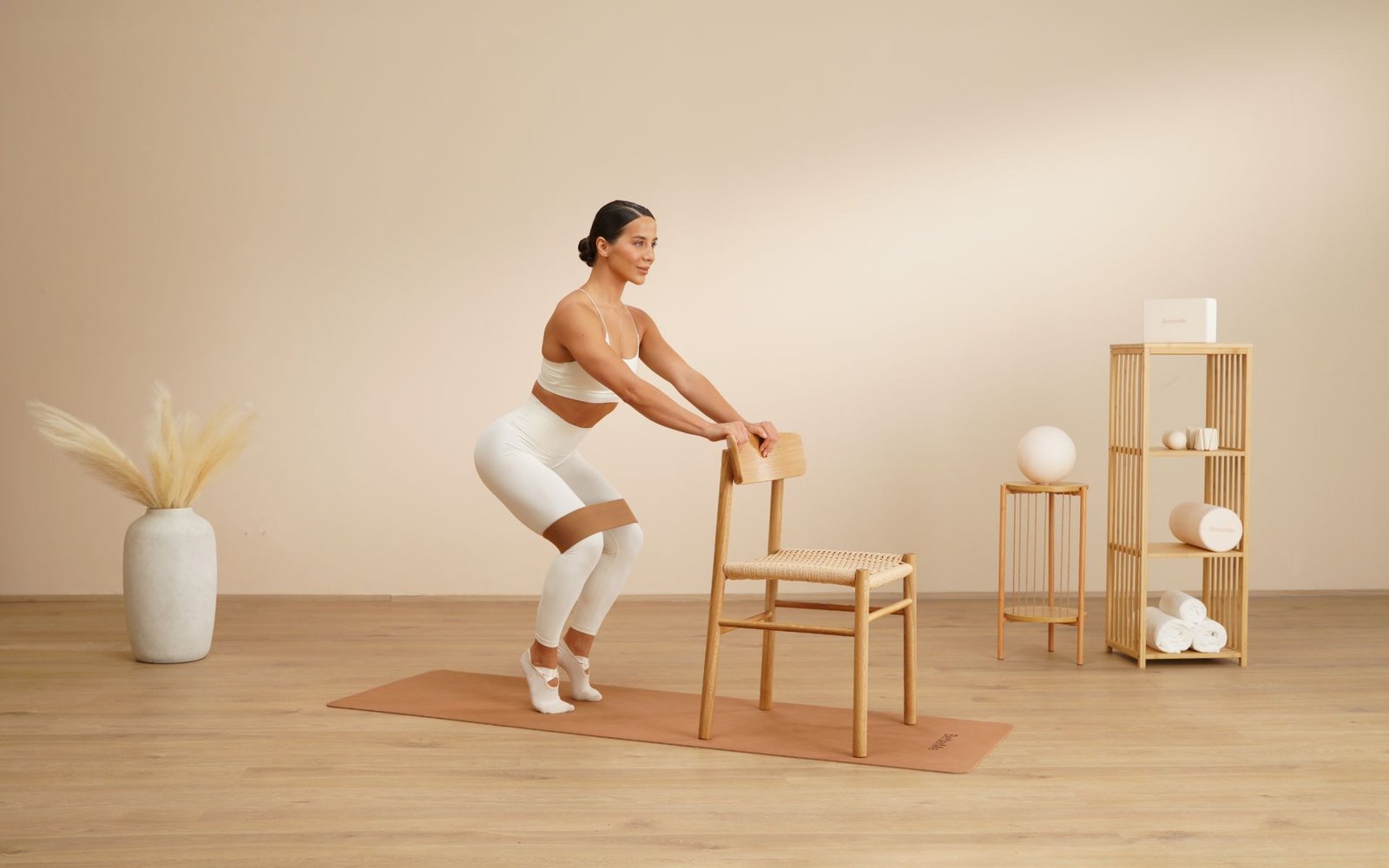
If you have ever looked for bands online, you already know there is more than one type. The two main options are long bands and resistance loops, and each one works a little differently.
Long bands are exactly what they sound like—long, open-ended strips of stretchy material. They are great for upper-body work, assisted stretches, posture-focused movements, and full-range exercises where you need more length to move comfortably.
For example, long bands work well for seated rows, overhead arm work, and gentle mobility drills. You can step on them, anchor them with your feet, or hold them wide to adjust the tension. If you like variety, they are a useful place to start.
Loop bands are smaller and closed in a circle. These are especially popular for lower-body work because they stay in place around the thighs, calves, or ankles. They are often used for glute activation, hip stability, and slow leg-focused exercises.
Neither one is better across the board. It really depends on what you want to do.
As a simple rule:
- Long bands are often best for arm work, upper-body strength, assisted stretching, and bigger ranges of motion.
- Loop bands are often better for lower-body exercises, side steps, bridges, clamshells, and other movements where the band stays around the legs.
Resistance level matters, too. A band that is too light may not do much. A band that is too heavy can make your form feel tight, rushed, or awkward.
Here is a simple way to think about it:
- Light resistance: a good starting point for beginners, mobility work, and upper-body control
- Medium resistance: useful for many general Pilates flows and full-body sessions
- Heavy resistance: often better for advanced users or lower-body work, as long as you can still move with control
For a more versatile stretchy bands workout, it can help to choose bands with different resistance options so you can match the tension to the exercise. These loop and long resistance bands include options for controlled mat work, with non-slip materials and different resistance levels to support smoother movement.
A good test is simple: if you cannot move smoothly, the band is probably too strong for that exercise. In Pilates, more tension is not always better. Clean movement usually matters more.
A Full-Body Band Routine
If you are new to bands, you do not need a long or complicated plan. A few well-chosen moves can already make your mat routine feel more interesting.
This beginner-friendly sequence works through the upper body, core, hips, and glutes. Move slowly, breathe steadily, and focus on form over speed.
-
Banded Arm Press-Out
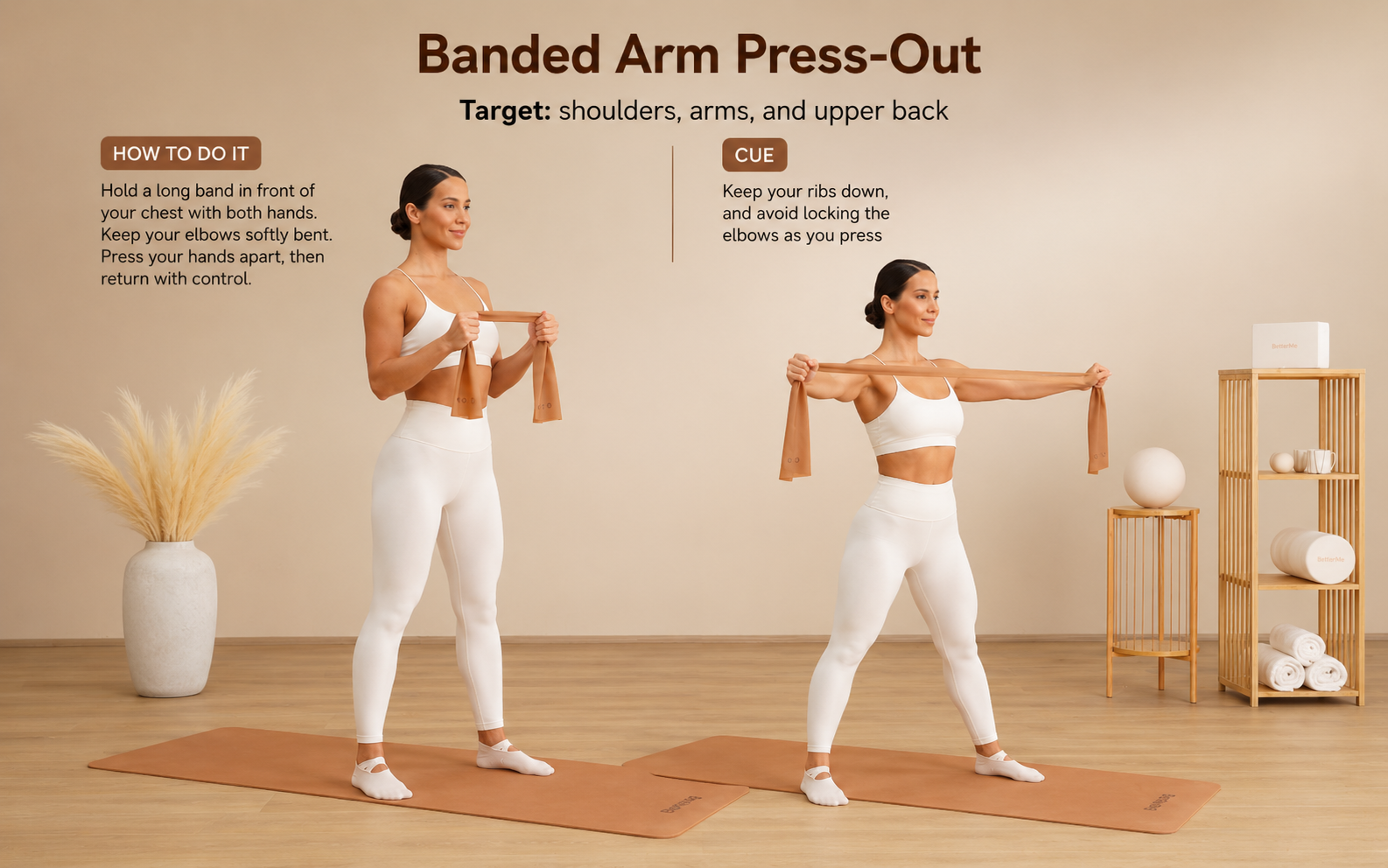
Banded Arm Press-Out This move adds light upper-body work while asking your core to stay steady.
- Target: shoulders, arms, and upper back
- How to do it: Hold a long band in front of your chest with both hands. Keep your elbows softly bent. Press your hands apart, then return with control.
- Cue: Keep your ribs down, and avoid locking the elbows as you press
-
Seated Band Row
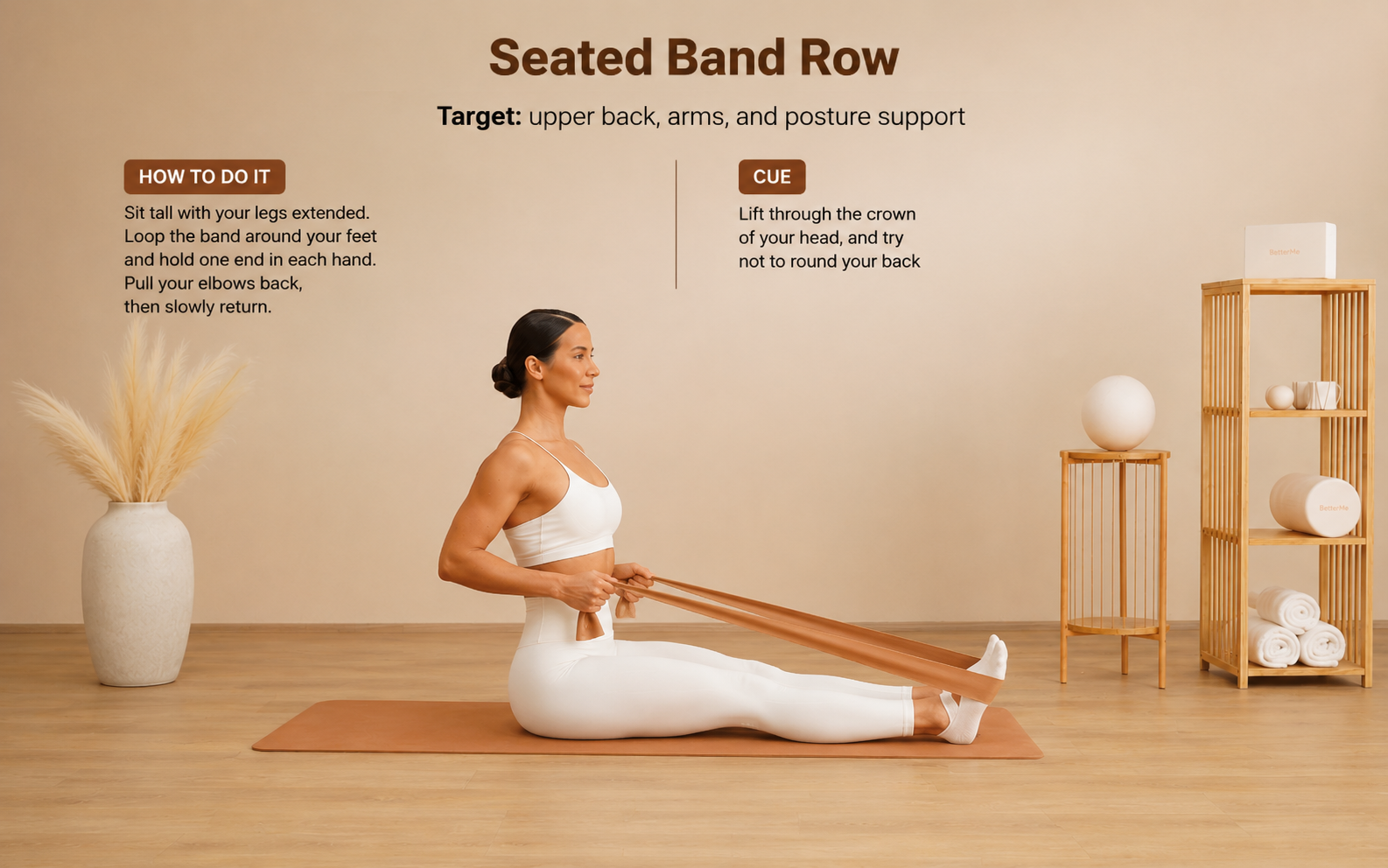
Seated Band Row This one is simple, but very useful if you want more upper-back work in your routine.
- Target: upper back, arms, and posture support
- How to do it: Sit tall with your legs extended. Loop the band around your feet and hold one end in each hand. Pull your elbows back, then slowly return.
- Cue: Lift through the crown of your head, and try not to round your back
-
Banded Dead Bug
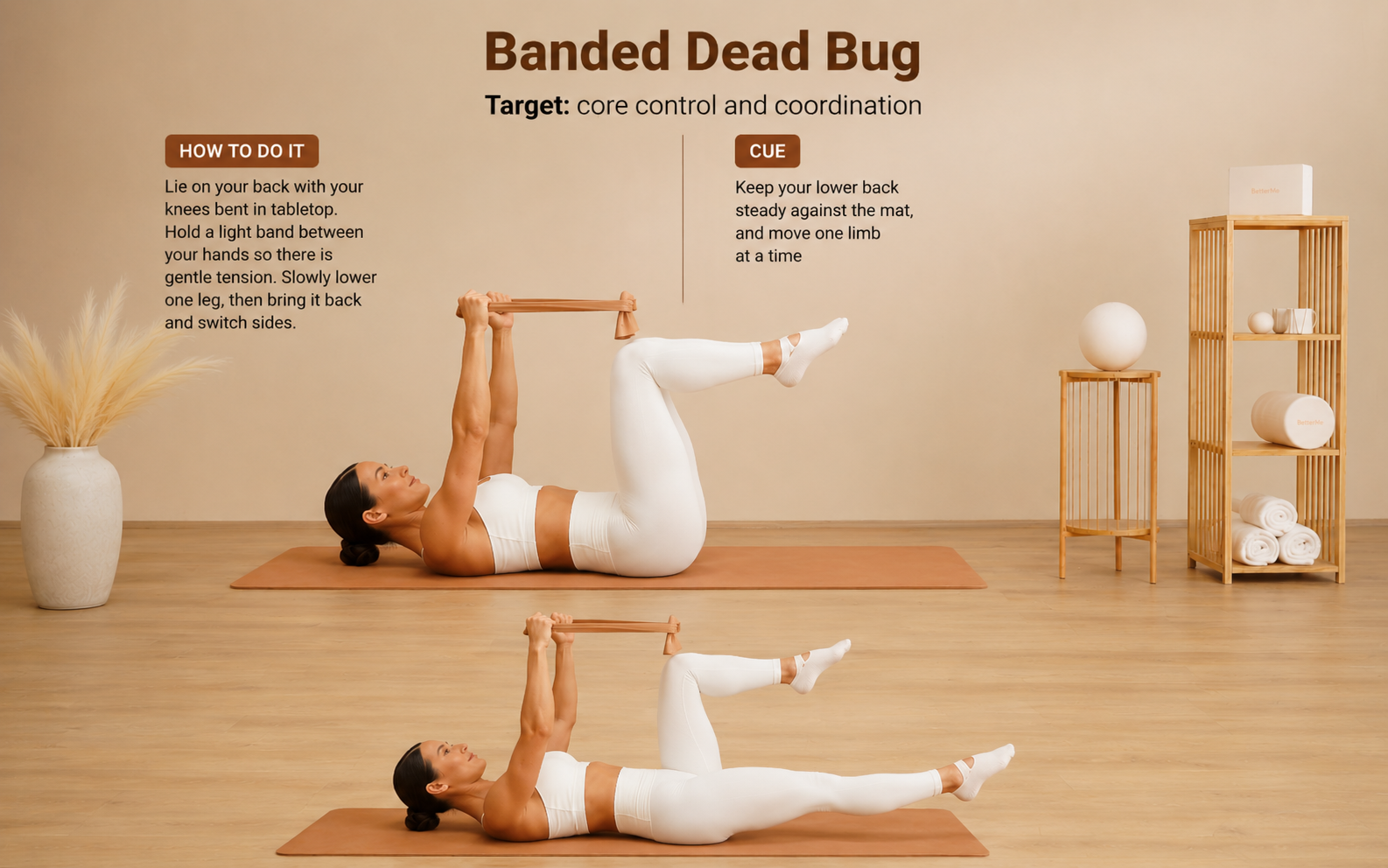
Banded Dead Bug This exercise brings a little more focus to coordination and core control.
- Target: core control and coordination
- How to do it: Lie on your back with your knees bent in tabletop. Hold a light band between your hands so there is gentle tension. Slowly lower one leg, then bring it back and switch sides.
- Cue: Keep your lower back steady against the mat, and move one limb at a time
-
Loop Band Bridge
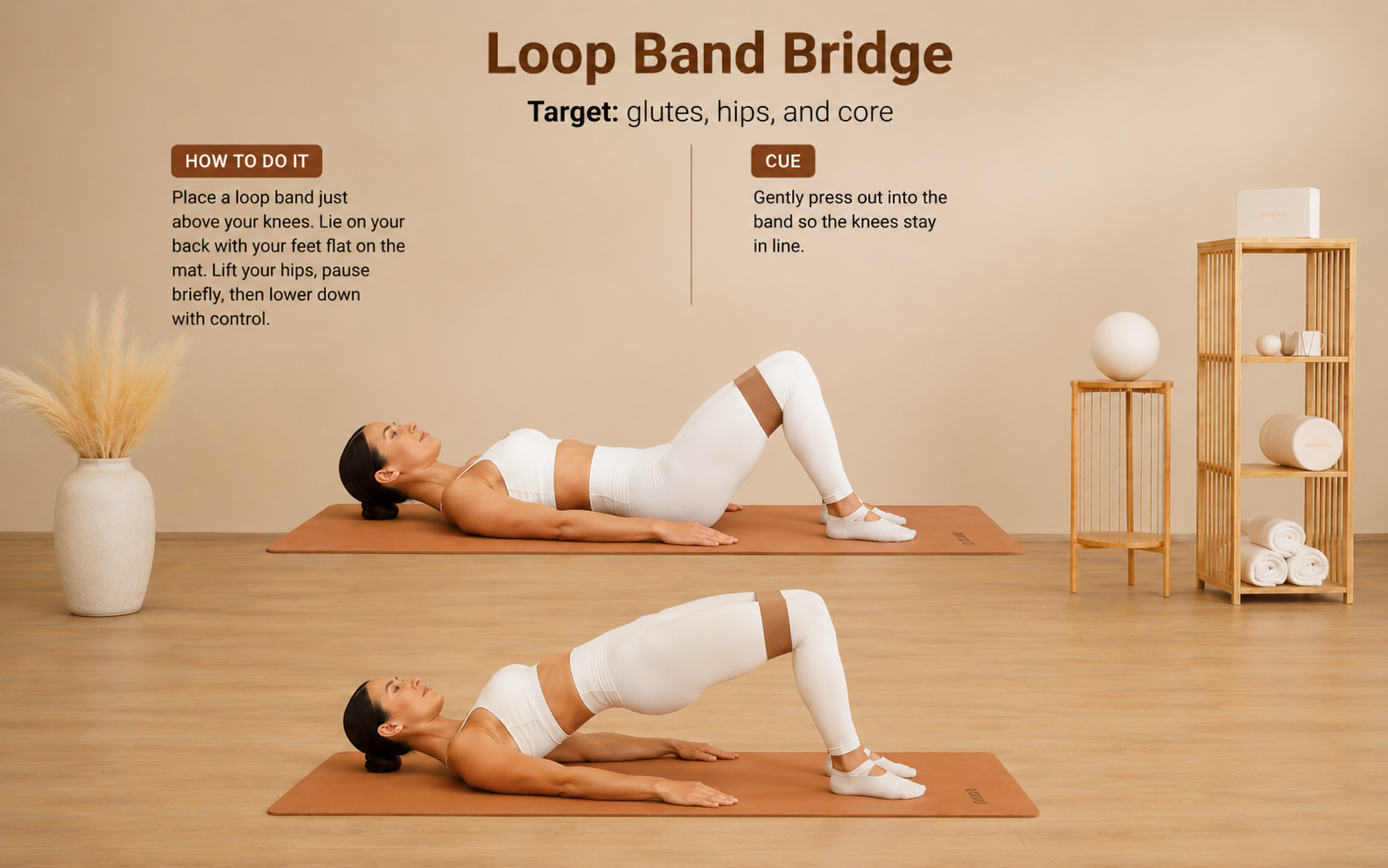
Loop Band Bridge A loop band can make a standard bridge feel more active without making it complicated.
- Target: glutes, hips, and core
- How to do it: Place a loop band just above your knees. Lie on your back with your feet flat on the mat. Lift your hips, pause briefly, then lower down with control.
- Cue: Gently press out into the band so the knees stay in line
-
Side-Lying Clamshell
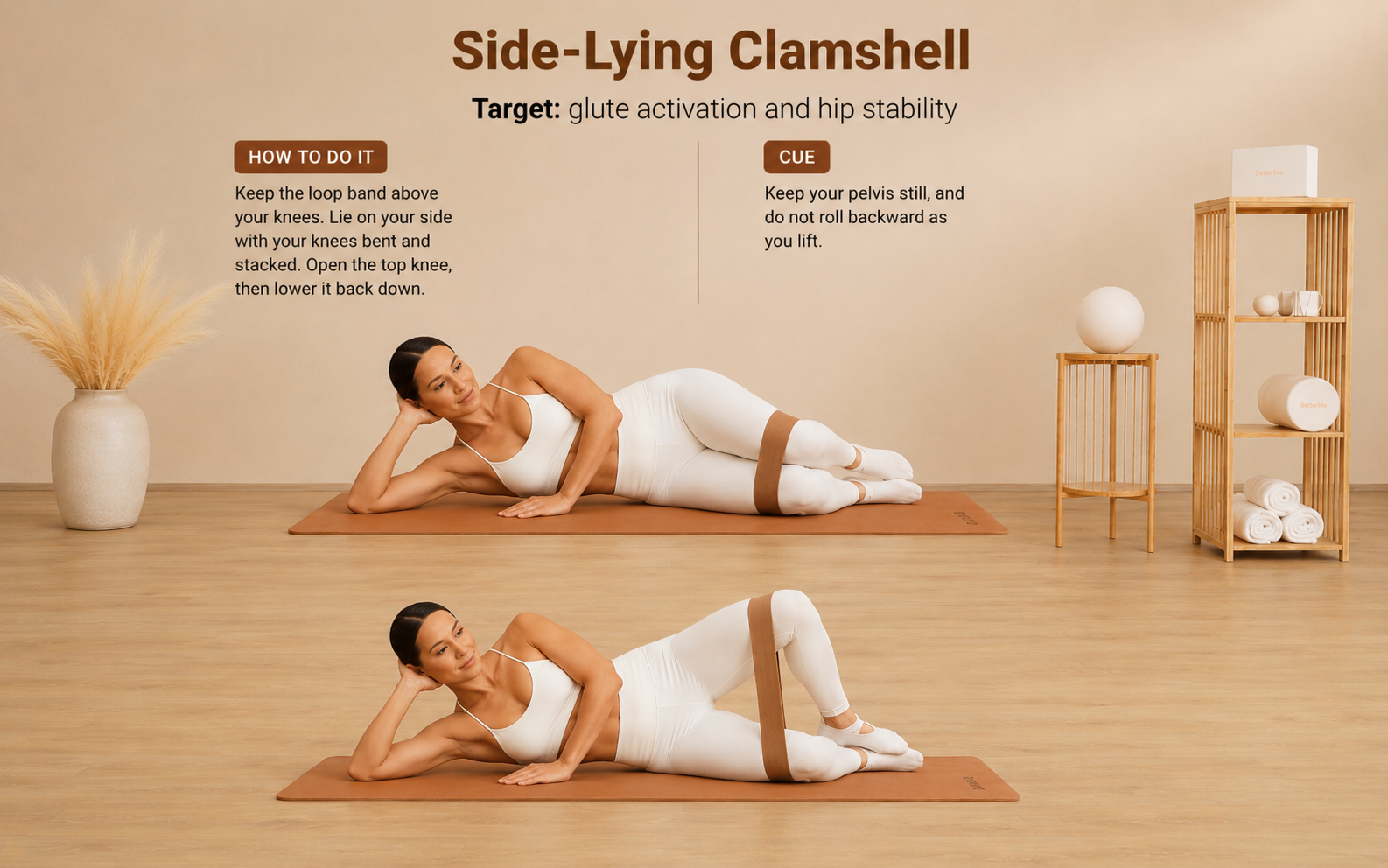
Side-Lying Clamshell This is a small movement, but you will usually feel it quickly.
- Target: glute activation and hip stability
- How to do it: Keep the loop band above your knees. Lie on your side with your knees bent and stacked. Open the top knee, then lower it back down.
- Cue: Keep your pelvis still, and do not roll backward as you lift
You can do 8–12 slow reps per move, then repeat the circuit 1–2 times. That is enough for many people, especially when the focus stays on control.
Tips to Prevent Bands from Rolling or Snapping
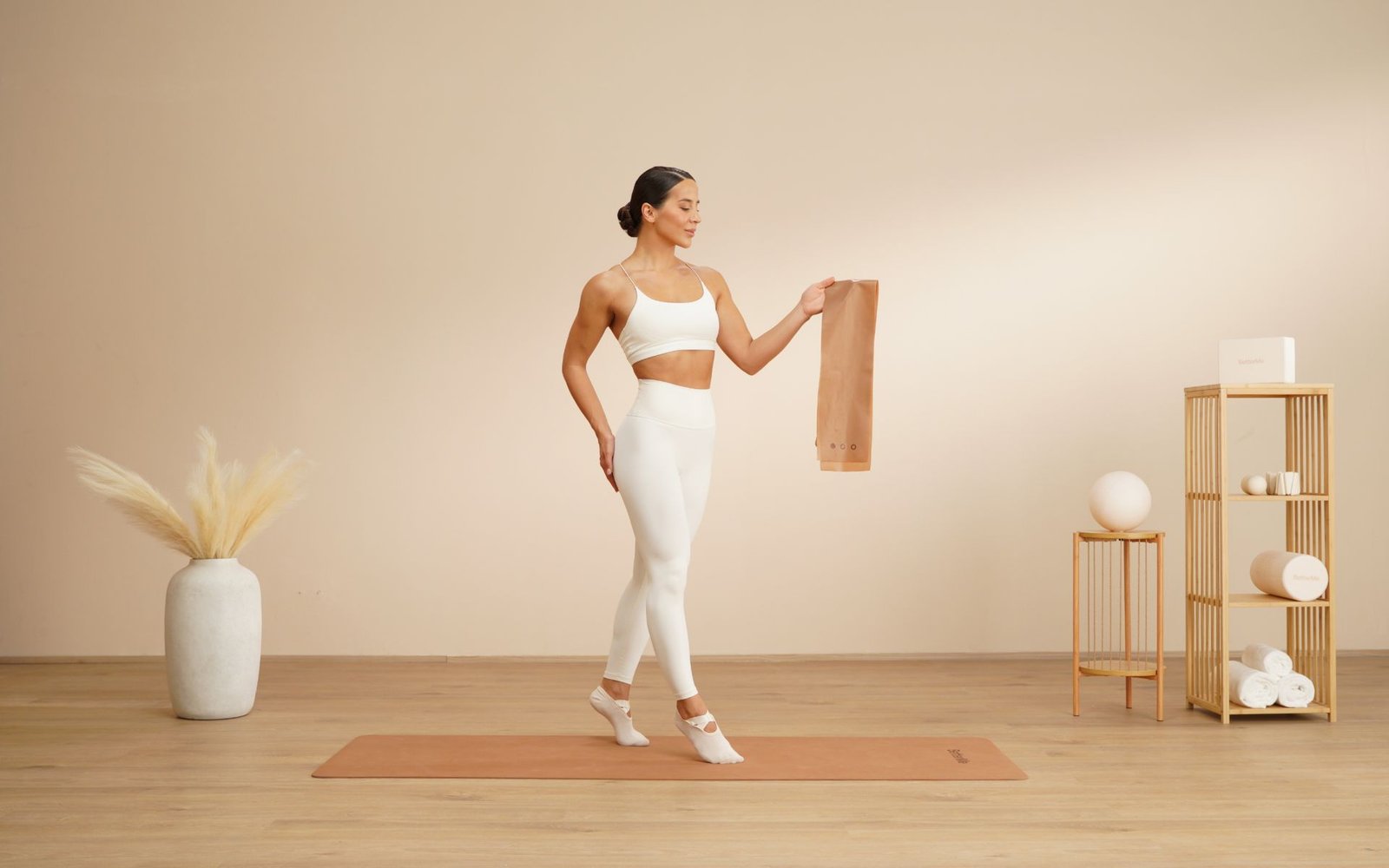
Bands are simple, but a few small habits can make them much easier to use.
First, choose the right resistance. If a band is too tight for the movement, it is more likely to twist, roll, or pull you out of position. A lighter band that lets you move well often works better than a heavy one you have to fight through.
It also helps to keep the band flat where possible. Twisted bands tend to dig in, roll up, and feel less comfortable. If something feels bunched or uneven before you start, take a second to reset it.
Be mindful of rough surfaces, shoes, or sharp jewelry. These can wear the material down faster than you think. Small weak spots may not be obvious right away, but they can build over time.
Try not to overstretch the band beyond what feels reasonable. If you keep pulling and the movement starts to feel forced, that is usually a sign to switch your setup, shorten the range, or grab a different band.
A quick equipment check can also help. Before you start, look for thinning spots, tiny tears, or areas that seem worn out. This only takes a moment, and it can save you from an annoying surprise in the middle of a workout.
Storage matters, too. To help your bands last longer:
- keep them away from direct sunlight
- avoid excess heat and moisture
- store them loosely instead of knotting them tightly
- keep them in a drawer, bin, or pouch so they do not get snagged
Most of all, move slowly. That supports better alignment and makes it easier to notice when something feels off. If the band causes discomfort, pinching, or a loss of form, stop and reset before continuing.
If you want to make your mat workouts more challenging without making them feel heavy or complicated, bands for Pilates can be a great fit. They are compact, versatile, and easy to work into the style of movement many people already enjoy.
They can support control, muscle endurance, glute activation, and more body awareness, all while taking up very little space at home. And because you can adjust the resistance so easily, they work well for many different levels and goals.
You do not need a huge collection or an elaborate setup to get started. A couple of well-made bands, a few simple exercises, and a steady pace can go a long way.