How AI Receptionists Are Helping Practices Book More Patients Without Overloading Front Desk Staff : The sound of an active medical office at 9 AM is not always pretty.
The phones are ringing, someone is coughing in the waiting room, the fax machine is wailing, and Mrs. Jenkins is waiting to see you about her copay receipt. What happens when it all gets too loud? You miss the phone call.
There is no way for you to answer it. You’re alone at the front desk. But that call is money that walked out the door. They didn’t leave a message. They called the other clinic down the street. You just lost a patient.
The knee-jerk reaction is to go and hire another receptionist. Right. Easier said than done. Finding qualified front desk staff today is becoming an uphill battle. Paying someone to sit on the phone with an insurance company for the next 45 minutes is not a good use of your payroll.
The solution is an AI receptionist. Clinical AI solutions to offload some of the noise on the phones. Here are 6 steps to make that happen.
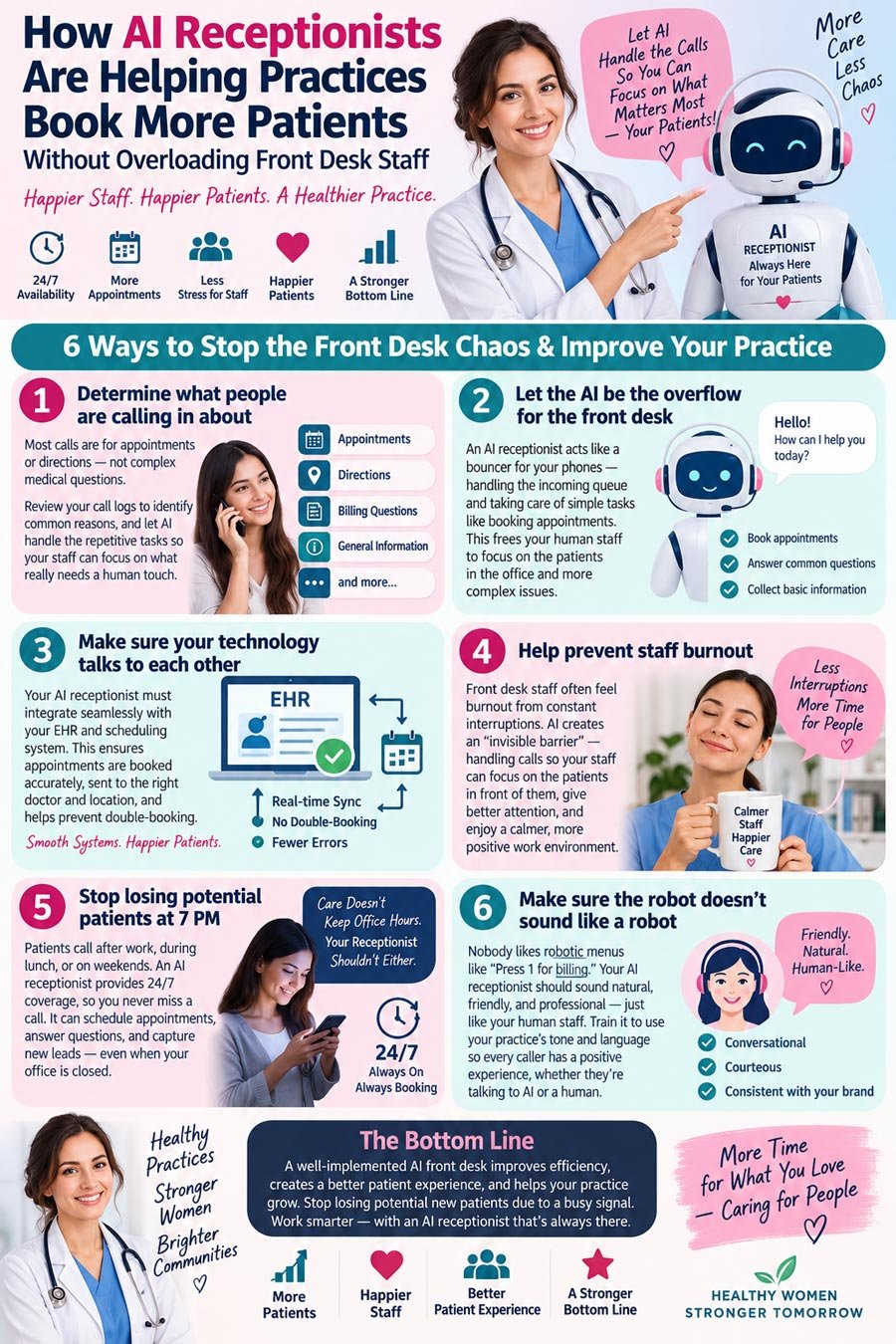
6 Ways to Stop the Front Desk Chaos & Improve Your Practice
-
Determine what people are calling in about
A simple examination of the call logs will usually show that the lion’s share of incoming calls are usually appointments or directions.
Practice managers often believe that every phone call is a deep medical question or a billing issue. It’s just not true. Seeing the functions represented will allow the practice to delegate the repetitive tasks to an AI and let their human receptionists focus on the complex tasks and the patients in the lobby.
-
Let the AI be the overflow for the front desk
The new AI receptionist is like a bouncer for your front desk. The front desk handles the humans waiting to see a doctor. The AI handles the incoming queue.
When a patient calls in, they are greeted by the AI and can immediately give their information, without waiting for music or a robotic message telling them to listen to the menu. The AI handles the simplest tasks. Booking the appointment, so that the human staff is free to focus on more complex issues.
-
Make sure that your technology talks to each other
An AI receptionist is useless if it can’t talk to the people they need to book appointments with. The connection with the EHR needs to be reliable and seamless. That means the AI scheduling tools need to be able to relay appointment information to the correct doctor and office without any issues.
These connections need to be consistent to avoid double-booking patients.
Automation tools eliminate human error, data entry, and double-booking before it happens.
-
Help prevent staff burnout
Front desk staff often suffer from burnout, not from the work, but from the interruptions.
Using automation to create invisible barriers is a great way to protect your staff.
Like a low wall to separate a garden from a patio. The front desk staff can focus on the patients and not worry about the phone calls that come in. Without the constant interruption of phone calls, the staff can focus on giving their attention to each patient and smile when they look up from the desk.
-
Stop losing potential patients at 7 PM
Patients don’t always fall ill between the hours of 9 AM and 5 PM. Many patients like to call in during their lunch hour, after work, or on their day off.
These calls would often go to voicemail if the practice only had human staff answering the phones. These patients don’t want to wait until 8 AM to ask about billing or to schedule an appointment, or they’ll move on to the next practician. This is where you must dive deep into how conversational AI works in healthcare. An AI receptionist gives the practice the coverage they need after hours and on weekends. This creates a reliable lead-generating function for the practice. The AI doesn’t stop working when the office is closed.
-
Make sure the robot doesn’t sound like a robot
Nobody enjoys waiting on hold for a customer service rep, only to find out that they are talking to a robot. Nobody wants to hear the robotic message, “Press 1 for billing questions and 2 for scheduling.” The receptionist should sound like your human receptionist and be a competent voice when it comes to your patients’ needs.
The AI needs to be trained to avoid robotic phrases and use the same courteous language your front desk staff uses every day. Having a consistent communication style is important for a good patient experience, whether they are talking to an AI or a human.
Conclusion
The most efficient front desk procedures aren’t about working harder. It’s about working smarter.
Medical practices can improve their chaotic phone tree by identifying functions, creating separate channels, connecting the scheduling tools, setting boundaries, improving the after-hours coverage, and having a uniform communication style.
A well-implemented AI front desk has pleasant interactions with patients and covers calls the practice would otherwise lose. It improves the overall efficiency of the practice and the bottom line. Stop losing potential new patients due to a busy signal with an AI receptionist that can work 24/7.
Related Infographics: